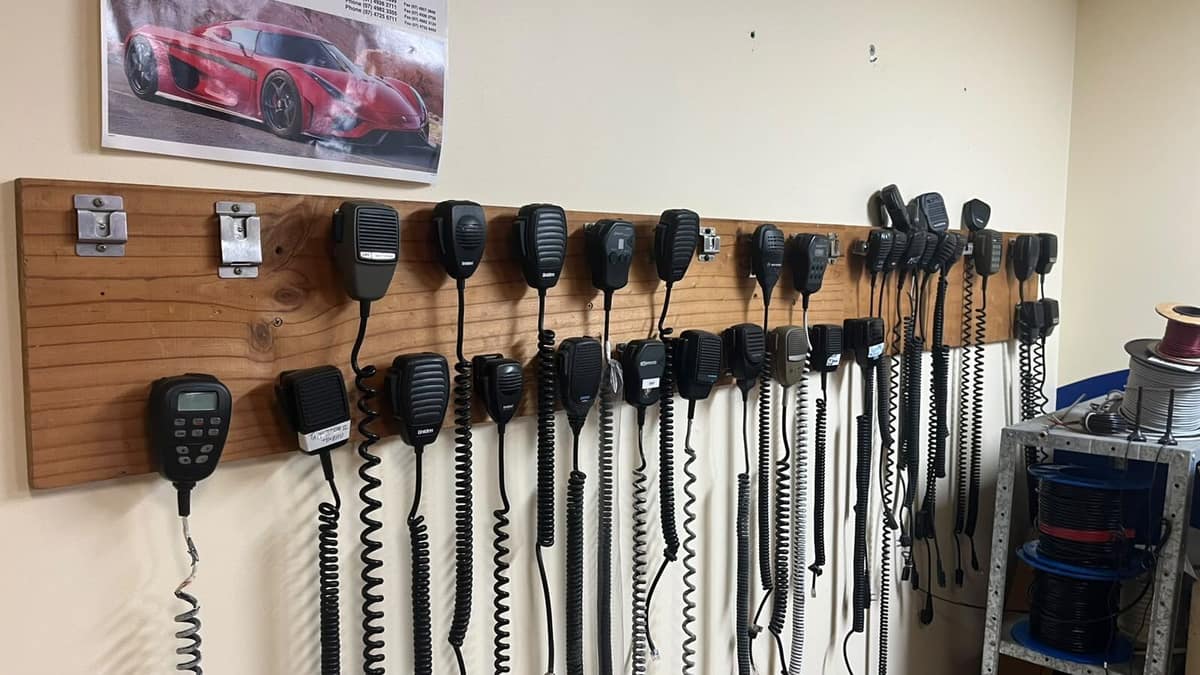
A UHF radio is still the most reliable way to talk on the ute, the farm, the boat or a mine-site access road across regional Queensland, where mobile coverage runs out long before the work does. This guide answers the three things people actually ask: which UHF CB channels to use, which radio to buy, and which antenna suits the country you drive. And when your radio finally packs it in, we repair UHF two-way radios on the bench at 29 Peel Street, Mackay, rather than shipping them south.
The short version
- UHF CB in Australia uses 80 channels in the 476 to 477 MHz band under the ACMA class licence.
- Channels 5 and 35 are emergency only. Channels 22 and 23 are data only, no voice. Leave the repeater channels for repeaters.
- Channel 40 is the national road channel. Channels 10, 18 and 29 are widely used conventions, not law.
- Maximum legal transmit power is 5 watts. A fixed 5W in-car unit beats a handheld for range.
- Antenna gain is a trade-off, not a case of chasing the biggest number. Low gain for hills and town, high gain for flat open country.
- The current class licence commenced on 1 October 2025 and dropped the old requirement to use a call channel first.
UHF CB channels in Australia
Every legal UHF CB radio in Australia uses the same 80 channels, spaced 12.5 kHz apart, in the 476 to 477 MHz band. Those channels and the rules around them are set by the Australian Communications and Media Authority (ACMA) under the Citizen Band Radio Stations Class Licence. That is why any brand talks to any other and nobody pays a per-radio fee. The key point: some channel uses are law, and some are only convention.
| Channel | Use | Set by |
|---|---|---|
| 5 and 35 | Emergency only, do not use otherwise | ACMA class licence |
| 22 and 23 | Telemetry and telecommand only, no voice | ACMA class licence |
| 1 to 8 and 41 to 48 | Repeater output channels | ACMA class licence |
| 31 to 38 and 71 to 78 | Repeater input channels | ACMA class licence |
| 40 | Road and highway channel, Australia wide | Convention |
| 29 | Road channel on parts of the Bruce and Pacific highways | Convention |
| 10 | 4WD clubs, convoys and national parks | Convention |
| 18 | Caravanners and campers | Convention |
Stay off 5 and 35 unless you are actually in trouble, keep voice off 22 and 23, and leave the repeater channels alone, or idle chat can block a wide area. The convention channels carry day-to-day driving: monitor channel 40 on the Bruce Highway for truck movements and hazards, and channel 29 on stretches of the Bruce and Pacific highways. None of the convention channels are written into the licence, but sticking to them keeps the road channels useful. One recent change: the remade class licence commenced on 1 October 2025 and removed the old requirement to call first on a designated call channel.
Which UHF radio should you buy?
There are two formats, and the right one depends on how you work, not on price. A handheld is self-contained, with its own battery and stubby antenna, and suits work away from the vehicle: spotting a reversing truck, moving stock, or two people on a site. The cost is battery life and a short antenna that limits range. A fixed or in-car unit mounts in the cab and drives a proper external antenna on the roof, bar or tray. For a ute, a farm vehicle or highway kilometres this wins every time, because the full 5 watts feeds a real antenna up high where it can reach.
That 5 watt figure is the ceiling. The maximum legal transmit power for UHF CB in Australia is 5 watts, so no radio, handheld or fixed, may push more. Handhelds often run less to save battery, from around half a watt up to 5 watts. Range then comes down to antenna height and terrain, not a bigger power number.
The two brands most Australian buyers compare are GME and Uniden, and both build 5 watt radios that meet the Australian standard. We repair a wider spread across the bench, including GME, Motorola, Icom and Kenwood, so we see how they all age, and there is no single best brand. For a work radio, favour a sealed, dust and water resistant body, a clear display, and an external speaker or microphone you can hear over an engine. Any UHF CB radio sold legally here is built to the Australian standard AS/NZS 4365 and runs under the ACMA class licence.
UHF antennas: gain, pattern and where you drive
The antenna makes or breaks range, and this is where most people buy the wrong thing. Antenna gain, measured in dBi, does not add power. It reshapes where the power you already have is sent. A higher gain antenna squashes the signal into a flat pattern aimed at the horizon, while a lower gain antenna sends a taller, rounder pattern that reaches up and down as well as out.
| Gain | Radiation pattern | Best for |
|---|---|---|
| Low, about 2 to 3 dBi | Tall and rounded | Hills, ranges, town, tight bush tracks |
| Mid, about 6 to 6.6 dBi | Balanced all-rounder | Mixed driving, most utes |
| High, about 8 to 9 dBi | Flat and focused at the horizon | Open flat country, highway, plains |
Terrain is why this matters here. On the open flats and cane country a high gain antenna around 8 to 9 dBi throws the signal a long way down a straight road, but in the ranges west of Mackay or hilly bush that flat pattern shoots over vehicles sitting higher or lower than you. In hills, town and close convoy work a shorter 2 to 3 dBi antenna talks better, and for mixed driving a mid gain 6 to 6.6 dBi is the sensible all-rounder.
Mounting counts as much as gain. Height helps, so a bull bar or roof edge beats a low bracket buried behind steel. Keep the antenna vertical, use good quality coax, and seal the connections, because a corroded connector on the coast will quietly kill your range long before the radio does.
When your radio dies, get it fixed locally
Work radios cop a hard life on utes, farms, boats and mine sites, and they do fail: water in the case, a snapped antenna lead, a dead microphone, or a set that will not transmit. Many people assume a dead radio is landfill, or that it has to be posted to a capital city and chased for weeks.
It does not. We repair UHF two-way radios on the bench at 29 Peel Street, Mackay. Bring it in, no booking needed, and a technician with decades of experience finds the fault first. We call you with a price before any work starts, nothing goes ahead until you approve the quote, and the repair is done here rather than shipped south. GME, Motorola, Icom and Kenwood come across the bench most, but bring in whatever you run and we will tell you straight whether it is worth fixing. See our UHF radio repairs page for details. If you also run a business site, the same local team handles the wired side; our guide on Cat6 vs Cat6a vs Cat8 is a good place to start.
Frequently asked questions
What UHF channel should I use in Queensland?
For general chat, pick any clear channel that is not reserved: keep off 5 and 35 (emergency only) and 22 and 23 (data only). On the highway, monitor channel 40, the national road channel, and channel 29 on parts of the Bruce and Pacific highways. 4WD convoys commonly use channel 10 and caravanners channel 18, though those are convention rather than law.
What is the best UHF radio for a 4WD in Australia?
There is no single best model, but for a 4WD the stronger setup is almost always a fixed 5 watt in-car unit with a proper external antenna, not a handheld, because the antenna up high is what gives you range. Choose a sealed, dust and water resistant unit, match the antenna to your terrain, and weigh build quality over the badge. GME and Uniden both meet the Australian standard.
What size UHF antenna do I need?
Match the gain to your terrain, not the length. A high gain antenna around 8 to 9 dBi is best on open, flat country and long highway runs. A low gain antenna around 2 to 3 dBi works better in hills, ranges and town because it covers vehicles at different heights. A mid gain antenna around 6 to 6.6 dBi is the safe all-rounder.
Can you repair my UHF radio in Mackay?
Yes. We repair UHF two-way handhelds and base units on the bench at 29 Peel Street, Mackay. Drop it in, no booking needed, open Monday to Friday, 8:30am to 5pm. We diagnose the fault, call you with a quote before any repair, and do the work here rather than sending it away.
Sources
- UHF CB channel plan, emergency channels 5 and 35, telemetry channels 22 and 23, repeater channels and the 5 watt power limit, all set by the Radiocommunications (Citizen Band Radio Stations) Class Licence 2025, Federal Register of Legislation, F2025L01088, the legal instrument that fixes these channels and rules. The ACMA “Citizen Band Radio Stations Class Licence” page is the official reference page for this instrument.
- Current class licence and its 1 October 2025 commencement, Class Licence 2025, Federal Register of Legislation, F2025L01088.
- Antenna gain and radiation pattern by terrain, GME, Understanding Antenna Gain and dBi.
- Equipment standard cited by name: AS/NZS 4365, Radiocommunications equipment used in the UHF citizen band radio service.
Got a dead radio? Bring it in
We repair UHF two-way radios on the bench at 29 Peel Street, Mackay. Drop your unit in or ask us through our UHF radio repairs page.