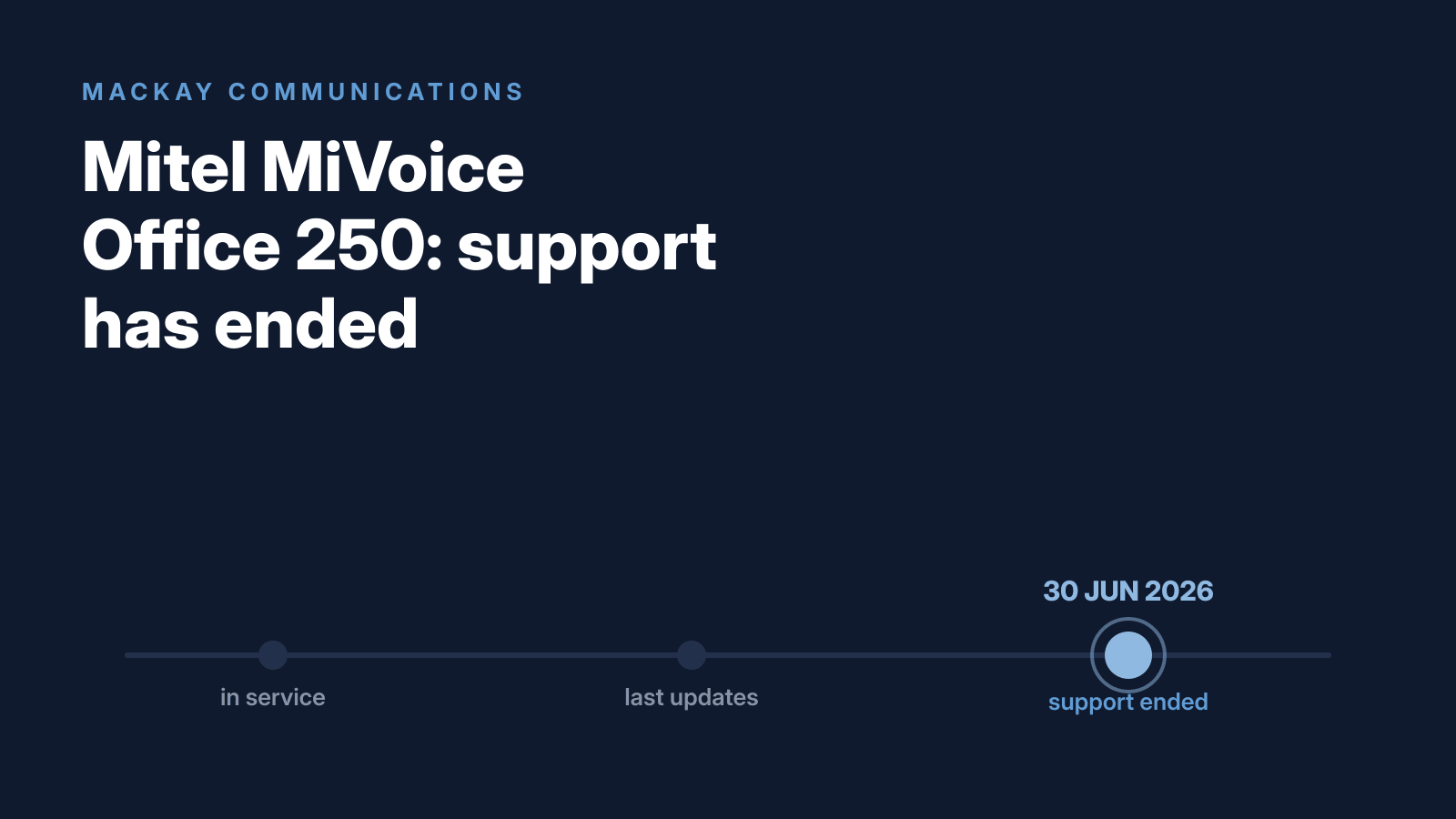
Mitel reached the end of life for the MiVoice Office 250 on 30 June 2026, the date its technical support ended. From that point the platform gets no more security patches, no manufacturer parts or warranty replacements, and no official fault support. Your system did not switch off overnight, and it will still make and take calls tomorrow. So this is not an emergency for tonight. It is the moment to put a migration on the plan instead of leaving it to a failure. This post explains what end of support actually means, the real risks of staying, why the Australian network changes make it more pressing than most owners expect, and the sober options in front of you.
The short version
- Mitel ended technical support for the MiVoice Office 250 on 30 June 2026. The system is now officially end of life.
- It keeps working, but there are no more patches, no new parts under warranty, and no manufacturer support to escalate to.
- The real risks are security exposure that never gets fixed, longer downtime when a part fails, and drift as carriers and handsets move on.
- Australia has already retired the networks these legacy systems leaned on. ISDN is closed, copper is being switched off as sites move to the NBN, and the 3G networks shut down in 2024.
- The calm path is to audit what you have now, then migrate to a supported Mitel platform, cloud or on-premise, on your timeline rather than under pressure.
What “end of life” actually means here
End of life is the last stage in a product lifecycle Mitel set out for the platform. It does not mean the hardware stops. It means the manufacturer stops standing behind it. The MiVoice Office 250 moved through several milestones on the way to 30 June 2026. These dates come from Mitel’s Product Discontinuance Notice for the platform, which is not published on a public Mitel page and sits behind a partner login. The milestones below follow partner and reseller advisories that cite that notice, so treat them as reported rather than confirmed on a Mitel URL.
| Milestone | Date |
|---|---|
| End of new system sales | 31 January 2022 |
| End of hardware and add-on sales | 30 June 2022 |
| End of scheduled software releases | 31 January 2023 |
| End of technical support (end of life) | 30 June 2026 |
| End of support, MiVoice Office Application Suite | 30 June 2027 |
The practical line is 30 June 2026. Before it, a fault could be escalated to Mitel and a firmware fix was possible. After it, your system is frozen at whatever software and hardware it runs today, with no path to a manufacturer fix. The related MiVoice Office Application Suite, the Phone Manager and call reporting layer, runs a year longer to 30 June 2027, but the core call platform is the part that matters most.
The real risks of staying on an unsupported system
None of these are reasons to panic. They are reasons to plan.
No security patches. A phone system is a networked computer. Once support ends, every newly discovered vulnerability in the platform is one that will never be patched. For a system that touches your voice traffic and often sits inside the business network, that exposure only grows with time.
No manufacturer parts or RMA. When a controller, line card or power supply fails on an end of life system, there is no warranty replacement. Parts come from the used and grey market, with no guarantee of condition and no cover if they fail again. A fault that used to mean a next-day swap can become days of downtime while a used part is chased down.
No official support to escalate to. Your maintainer can still work on the system, but they can no longer raise a case with Mitel or get a firmware fix for a platform bug. You are relying entirely on field workarounds.
Compatibility drift. Carriers, trunking standards and handset ranges keep moving. A frozen platform slowly falls out of step with everything it has to connect to, and each new incompatibility is one more thing that cannot be fixed at the source.
Why the Australian network changes make this more pressing
This is the part specific to running a legacy phone system in Australia, and it is the real reason not to leave the MiVoice Office 250 sitting indefinitely. The networks these systems were built to use have already been retired.
ISDN is closed. Many Office 250 sites connected to the outside world over ISDN trunks. Telstra placed ISDN on cease sale and completed its exit by 2022. Those trunks no longer exist. If your system is still up, it is almost certainly already running behind a SIP gateway or on analogue lines, which is a workaround, not a designed state.
Copper is being switched off. The legacy copper PSTN is being retired as premises migrate to the NBN, and business voice now runs over IP rather than the old copper network. A modern phone system is built for that world. A legacy PABX has to be adapted to it.
3G is gone. Telstra and Optus switched off their 3G networks from 28 October 2024. Any legacy backup path, dialler or failover that leaned on 3G stopped working then. It is the same story as ISDN and copper, the ground underneath the old kit has moved.
Put together, the MiVoice Office 250 reaching end of support is not an isolated event. It lands on top of a telephony landscape that has already shifted to IP. The longer a legacy system stays, the more it depends on adapters and workarounds to keep talking to networks that were not built for it.
Your options, side by side
There are three honest positions. Stay put, move to a modern on-premise Mitel system, or move to Mitel in the cloud. Here is how they compare on the things that matter after end of support.
| Stay on the MiVoice Office 250 | Modern Mitel on-premise | Mitel cloud (hosted) | |
|---|---|---|---|
| Manufacturer support | None after 30 June 2026 | Current and supported | Current and supported |
| Security patching | None | Ongoing | Ongoing, managed for you |
| Spare parts and RMA | Used market only | New, under warranty | Handsets only, platform hosted |
| Where the system lives | Your comms room | Your comms room, current hardware | Provider data centre |
| Cost pattern | No spend, rising risk | Upfront capital cost | Monthly per user |
| Keep your numbers | Already yours | Yes, ported | Yes, ported |
Staying put has a place as a short bridge while you plan, provided you go in with eyes open about the risk. It is not a destination. On-premise suits sites that want the system in their own comms room and prefer a capital purchase. Cloud suits businesses that want the platform maintained off-site and billed per user. There is no single right answer, only the one that fits your site, your call volumes and your budget.
How to plan the move without rushing
Treat it as a project, not a fire drill.
Start by taking stock of what you actually run: how many handsets, what trunk type you are on now, and which features your team genuinely uses day to day. Most sites use a fraction of the features and carry the rest as dead weight. Then check the practical constraints, any contract end dates and your numbers, which port to a new platform rather than being lost.
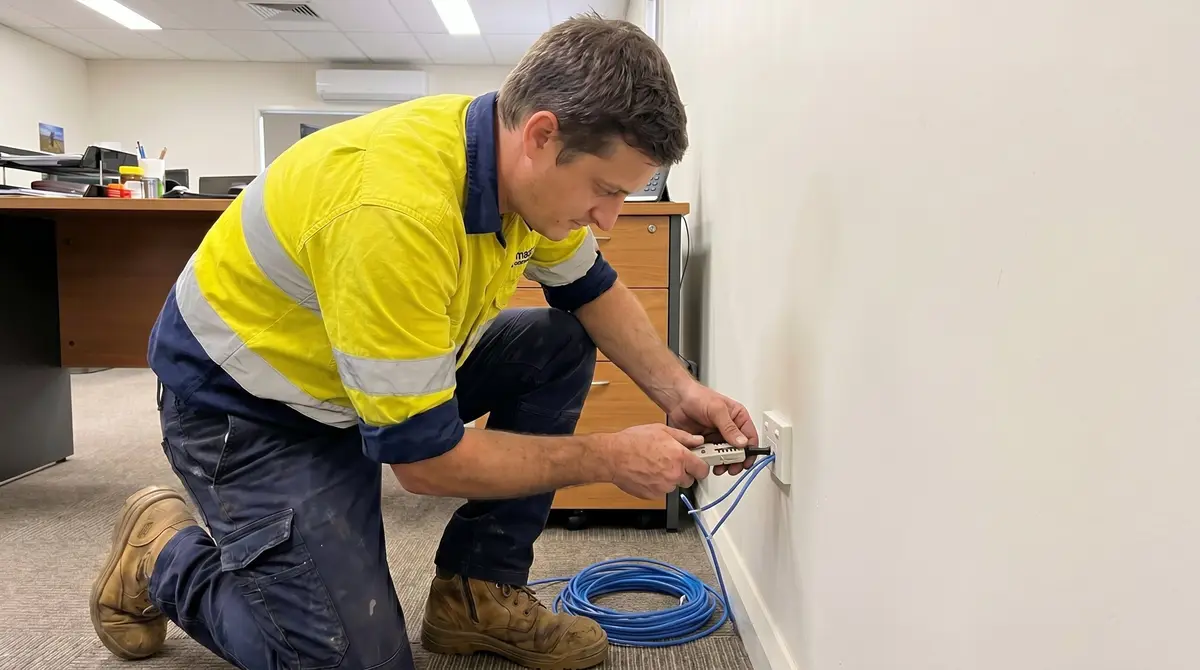
From there, an on-site audit tells you what a replacement looks like and what the cabling behind it needs to carry. A cloud or IP phone system leans on the data cabling in your walls, so it is worth confirming the network is up to the job. Our guide on choosing between Cat6, Cat6a and Cat8 covers that, and we design and install structured data cabling across the region.
Mackay Communications holds the regional Mitel dealership, so pricing, warranty and support stay local rather than routing through a southern reseller. Migrations from older Mitel and on-premise PABX systems to current Mitel platforms are routine work, and install and ongoing support are delivered with our sister brand Office Automation from the same Peel Street office. The on-site audit is free and the detailed quote arrives within 48 hours.
Frequently asked questions
Will my Mitel MiVoice Office 250 stop working on 1 July 2026?
No. End of support does not switch the system off. It keeps making and taking calls exactly as before. What ends is the safety net behind it: security patches, warranty parts and manufacturer support. The system runs until something breaks that can no longer be fixed cleanly, which is why planning ahead beats waiting for a failure.
What are the real risks of staying on an unsupported phone system?
Three main ones. Security vulnerabilities discovered after 30 June 2026 will never be patched. When a part fails there is no warranty replacement, so downtime can stretch while a used part is sourced. And the platform slowly drifts out of step with carriers and handsets, with no way to fix incompatibilities at the source. The risk is not a single cliff, it climbs steadily the longer you wait.
Do I have to move to the cloud, or can I stay on-premise?
You have both options. Mitel offers current cloud and on-premise platforms, so you can keep the system in your own comms room or move it to a hosted service, whichever fits your site and budget. The audit works out which suits you rather than pushing one path.
Can I keep my existing phone numbers when we migrate?
Yes. Number porting is handled end to end, so your published numbers move to the new platform without changing. A well-run cutover ports the numbers and switches over with no loss of service to your business.
Sources
- Mitel MiVoice Office 250 end of life and end of technical support date of 30 June 2026, and the lifecycle milestones, come from Mitel’s Product Discontinuance Notice. That notice is not on a public Mitel page and sits behind a partner login, so the date and milestones here follow partner and reseller advisories that cite it, namely Ladybird Communications and Marco Technologies.
- Australian 3G network switch off from 28 October 2024 by Telstra and Optus, from the NSW Government and Telstra.
- Telstra placed ISDN on cease sale and completed its exit by 2022, from the Telstra Wholesale ISDN exit communication.
Talk to the local Mitel dealer
If you are running a MiVoice Office 250, now is the time to scope the replacement, not the day it fails. We hold the regional Mitel dealership and migrate legacy systems to current Mitel platforms as routine work, with numbers ported end to end and support delivered locally. See Mitel phone systems or book a free assessment.
Request a Mitel quote at /quote/
Last reviewed July 2026.